
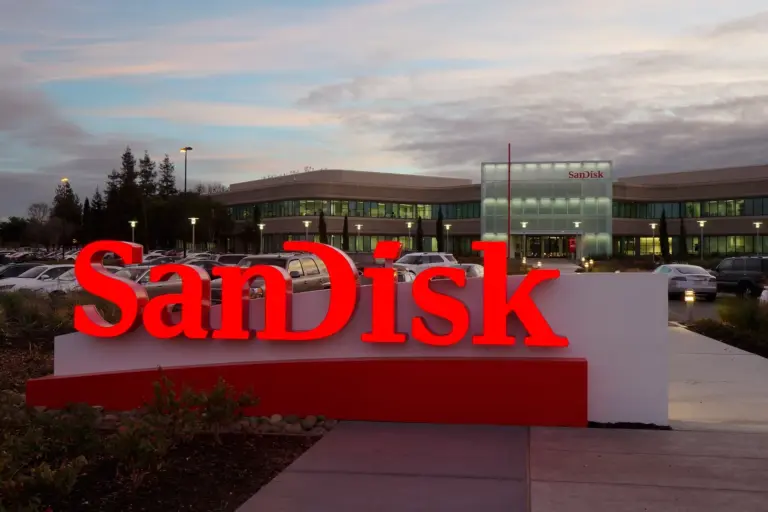
Sandisk stock fell about 5.3% to $1,546 in Monday afternoon trading, putting the flash-memory company near the center of a global semiconductor selloff that has hit memory-related names particularly hard.
Shares traded as low as roughly $1,505 during the session after falling as much as 7.9% earlier in the day. The latest Investing.com cash-market read put Sandisk near $1,546, down around 5.3%.
The weakness began well before Wall Street opened.
The move matters because memory has been one of the most leveraged ways to trade the AI infrastructure boom this year. Tight supply of high-bandwidth memory, strong data-center spending and rising memory pricing have driven sharp margin expansion across the industry.
That also leaves the group unusually sensitive to any suggestion that the pace of AI infrastructure spending could slow.
SK Hynix and Kioxia Led the Asian Selloff
The pressure first appeared in Asia.
SK Hynix fell 6.35% in South Korea, while Kioxia dropped 6.37% in Japan, according to an Investing.com market read. Samsung Electronics declined 4.05%.
Those moves are notable because SK Hynix has been one of the clearest beneficiaries of the HBM shortage powering Nvidia-class AI accelerators, while Kioxia and Sandisk sit directly in the NAND market.
The selloff comes only days after Kioxia itself signaled that memory pricing may already have risen far enough. Chief Executive Hiroo Ota said the company would work to prevent further price increases from damaging longer-term AI demand after Kioxia’s NAND average selling prices jumped roughly 70% sequentially.
FinanceFeeds examined that shift in its September 9 analysis of Kioxia’s decision to cap further NAND pricing increases.
That earlier warning was about the sustainability of memory pricing. Monday’s selloff adds a second question: what happens to the sector’s earnings assumptions if the AI infrastructure buildout itself becomes less aggressive?
European Chip Stocks Followed Asia Lower
European semiconductor shares then opened sharply lower.
At 07:10 GMT, ASM International was down 10.33%, Infineon 8.25%, BE Semiconductor 8.22%, STMicroelectronics 6.63% and ASML 4.4%.
A Reuters read published at 09:35 UTC showed some of those moves moderating but still severe. Soitec was down 12.6%, ASM International 8.7%, Infineon 7.6% and ASML 5.2%, while the broader STOXX 600 was lower by only about 0.3%.
Reuters subsequently updated its European market coverage with the STOXX 600 down roughly 0.5% and the technology sector down 2.1%, while Soitec remained about 12.5% lower.
The gap between semiconductor losses and the broader market is important. It suggests investors were not simply reducing equity exposure across the board. They were specifically repricing companies whose earnings are tied most closely to continued AI investment.
The pattern carried into the US session. Reuters had the PHLX Semiconductor Index down 5.4%, compared with a decline of roughly 0.3% for the S&P 500.
Analysts Disagree on Whether AI Spending Will Actually Slow
The immediate catalyst was Anthropic Chief Executive Dario Amodei’s call for AI developers to deliberately slow the pace of advances in frontier models so that safety controls can catch up.
Amodei’s essay, “We Must Pace the Frontier,” argues for more external evaluation, coordination between AI companies and international cooperation rather than an outright stop to development.
Bernstein analysts led by Stacy Rasgon said the development had the “potential to further depress sentiment” toward semiconductors.
Bank of America, however, is pushing back against the idea that the debate will translate into a sustained reduction in AI spending.
Analysts led by Vivek Arya argued that competitive pressure between technology companies and countries makes a meaningful slowdown difficult to sustain. BofA described the latest concerns as “noise relative to a secular market” in which AI capital expenditure could more than triple to above $3 trillion by the end of the decade.
That distinction is now the central question for memory investors.
If spending continues at something close to current expectations, Monday’s move could prove largely sentiment-driven. But if hyperscalers begin stretching deployment schedules or reducing infrastructure budgets, memory suppliers have more earnings sensitivity than many other parts of the AI trade because recent profitability has depended heavily on supply tightness, pricing power and aggressive capacity consumption.
For Sandisk, the debate arrives after an extraordinary run in the stock and while investors are already testing how durable NAND pricing can remain.
Western Digital is now a different business following the Sandisk separation, with its exposure centered on hard drives rather than NAND. FinanceFeeds’ September 11 Western Digital stock scenario analysis examined why that distinction matters when assessing the AI storage cycle.
Monday’s trading is making that distinction clearer. The broad AI trade is under pressure, but memory and semiconductor hardware are absorbing a disproportionate share of the selling.